|
* Dump
moves ever closer in 2022...
* Dump
plan moves closer in 2020.
In 2021 Allerdale has also been "suggested" by private
groups as future underground nuclear waste dump. Manchester based developers
GenR8 North have put forwards the use of land under Allerdale for a possible
dump, which will have to house nuclear waste for 100,000 years. reported
in FT news.
As a result an Allerdale Working Group will now begin local discussions
and fact-finding about the potential for the future siting of a nuclear
waste Geological Disposal Facility (GDF) in Allerdale. The latest official
cost estimate for the dump is £53 billion.
The supposed custodians of the Lake District (The National Park Authority)
have not made a firm 'No' decision over the plans for an underground nuclear
dump for highly radioactive waste in the West Cumbria. But they are starting
to see concerns over the threat to tourism and the 'brand' of the English
Lakes.
2018. Despite The Lake District National Park Authority telling
the Parliamentary committee they failed to see how a “development
of this scale could be consistent with legislation and national policies
protecting National Parks, AONBs or World Heritage Sites”, the Commons
Business, Energy and Industrial Strategy Committee backed the Government's
approach on a nuclear dump and decided against calling for national
parks and areas of outstanding natural beauty to be excluded.
Also the UK government states that it will seek to place plutonium
in any underground GDF...meanwhile ..Sweden
says No to burying nuke waste. as the UK
increases its bribes to areas prepared to host the waste forever.
Reports
of the risks of another Chernobyl in 2021.
In 2013 Cumbria County Council votes to say 'No Thanks' to Highly Radioactive
waste caverns... so then central government changes rules and says Copeland
and Allerdale Councils can have final say...and both want to Take the
Money!
And in 2016 the nuke dump not only likely to take HinkleyC spent nuclear
fuel but also 4 tonnes of plutonium from Germany. (As nobody knows what
else to do with the waste)
Then central government over rules any local views...See
2015 report.
Both Copeland and Allerdale Councils have endorsed the moves to have highly
radioactive spent nuclear fuel buried in caverns. The plans are also linked
to the plan to build a new generation of nuclear power stations, possibly
including one in Cumbria, to be called Moorside.
In January 2013 Cumbria County Council voted not to offer its area as
a volunteer site for an underground dump. The county council argued that
the waste was better stored and monitored in surface facilities, as is
the case at present. But then central government overturned this council
rejection and changed the rules so Copeland and Allerdale can both 'volunteer'
to have the dump and associated community bribes. Now the government has
also enabled any local concerns to be over ruled as the project is now
classed as strategic infrastructure, as with the other unviable taxpayer
funded project HS2.
A report to the government's Nuclear Decommissioning Authority (NDA) in
2008 confidently claimed: "A wide range of generic repository Concepts
is available that can provide safe and secure geological disposal options
to suit any appropriate UK geological environment."
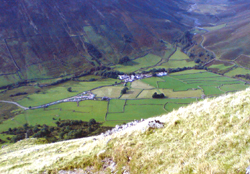
The most likely sites are those with "stable crystalline bedrock"
such as the Eskdale granites underlying parts of Eskdale and Wasdale (pictured.....both
locations are within sight of Sellafield) More
on the real cost (£10 billion per reactor) of decommissioning nuclear..
The one organisation charged to protect our Lake District, the Lake District
National Park Authority (LDNPA), has signed up to become a partner in
what has been branded and marketed as 'The Vision' for both new
nuclear reactors and an underground dump.
But to quote from LDNPA's latest strategy document: "It is not appropriate
to either support or object to the location of such a site in West Cumbria
at this early stage. More information is needed to make an informed decision.
The best way to get this is to be involved in the selection procedure."
To quote from the LDNPA minerals and waste strategy: "The likelihood
of West Cumbria being put forward as a potential volunteer community is
very high. We cannot underestimate the importance of us being involved
in the decision making process. "
This came as the Park bids for World Heritage status in 2011.
Meanwhile typical of the way our money is used to sweeten the pro-nuclear
message...the West Cumbrian tourism body West Cumbria Tourism was part
funded by Nuclear Management Partners who run Sellafield.
The Bribes
Almost all derived from UK taxpayers....West Cumbria's Energy Coast
Board has £20 million from Nuclear Management Partners.The NMP,
NDA and Sellafield Ltd have pooled their £10 million per year
socio-economic resources into Britain's Energy Coast. In addition
if Cumbria is naive and takes the dump then in 2019 government promises
Community Investment Funding - the Government will make available
Community Investment Funding of up to £1 million annually for
each community that forms a Community Partnership. This investment
will rise to £2.5 million
Executive Summary6 annually per community for those communities that
progress to the stage of deep borehole investigation (which will be
needed to assess the potential suitability of a site). |
 The
previous bid for a nuclear underground dump by Nirex in the 1980s was
only for intermediate level nuclear waste and even that was ruled out
by the then Tory government after a lengthy public inquiry.
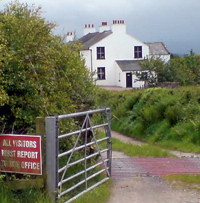
The nuclear industry has retained ownership of the land earmarked by Nirex
for the dump and a farmhouse on the site has blocked up windows to mask
its redundancy awaiting developments….(Pictured right)
Sellafield does look after the current massive collection of 'legacy'
nuclear waste, some remaining radioactive for over 27,000 years.
Lakestay says that allowing the government to claim spent nuclear fuel
from new reactors can be dumped underground in Cumbria forever not only
gives a false 'green light' for new reactors, but it may also not be the
best option for Britain.
Lakestay says radioactive waste should be supervised above ground (thus
ensuring future jobs and expertise continues) rather than the planned
bury and walk away plan.
Supervising waste above ground will allow future technological breakthroughs
which may enable dangerous isotopes to be changed and make the waste safe.
Jobs at Sellafield will be secure for decades as the Cumbrian site has
to look after the UK waste forever.
Imagine the
scale of the waste excavations to take both legacy waste and all spent
nuclear fuel from a new commercial scale reactors.
The tourist industry and its health benefits to the UK population may
well outweigh the economic benefits to Cumbria of Sellafield…a choice
is being made now while the LDNPA says "It is not appropriate to
either support or object to the location of such a site in West Cumbria."
Meanwhile massive 'donations' are being made and promised for being home
to the underground dump. All the payments coming directly or indirectly
from you the taxpayer.
Well
done to the National Trust for describing the goverment's National Policy
(NPS) as "unfit for purpose".
The Trust
states: "With regard to waste disposal, we are concerned that this
issue has not been dealt with sufficiently within the NPS and that the
IPC is not required to consider the issue of waste disposal in its consideration
of applications. As no long-term storage disposal solution for nuclear
waste has yet been identified, this means that all nuclear waste from
new generating facilities will have to be stored on-site for a significant
time-period. This has the potential to increase the risk of each site
to the environment, local populations and visitors and the level and nature
of this risk should be calculated and communicated to all local stakeholders
during the consultation process."
And what of the Cumbria Tourist Board? Will they also try and stay neutral?
We asked (July 2009) for their views on a future underground nuclear
dump and/or new nuclear power stations. Below is the response from their
Public Relations department.
"The
tourism and nuclear industries in Cumbria have co-existed for many years
and a number of tourism businesses, such as Muncaster Castle and the Ravenglass
& Eskdale Railway, are successfully operating within close proximity
of Cumbria's current nuclear site at Sellafield.
"Over
the last three years, visitors to the Copeland area have grown at a faster
rate than any other part of the county - attracting an additional 7% of
visitors, which in turn resulted in an increase in the number of tourism
jobs in the area.
"Any
investment planned for Cumbria's West Coast should be welcomed, especially
in the current economic climate. Investment has the potential to deliver
a prosperous local economy, which will in turn make the area more attractive
to both visitors and locals as we will see improvements to the public
realm (the overall appearance of the place) and development in new facilities;
from accommodation to cultural attractions and facilities.
"Cumbria
Tourism does not have the technical authority to comment on any specific
points raised that relate to the day-to-day operation of the Sellafield
site, but any issues that may effect visitors or tourism businesses are
immediately brought to our attention by our major partner, the County
Council who are represented on Cumbria Tourism's Executive Board.
"As
is the case with any major development, we will closely monitor the impact
of potential nuclear new builds on both visitor enjoyment and our tourism
businesses and, along with the public, will have an opportunity to put
our (and our membership's) views forward as part of the Government's consultation
process."
REACTION of Cumbrian Artist, Julian Heaton Cooper.
"I agree there is a great risk of the English Lake District being
'volunteered' for a future underground nuclear dump and organisations
such as the National Park Authority need to take a far more robust attitude
than appears to have been the case so far. It is no use custodians of
the Lake District staying neutral over the possibility of highly radioactive
waste, that is active for 27,000 years, being buried beneath the Western
Lakeland. Lakestay are quite right to highlight these concerns."
What may be coming to Cumbria has already started in France:
In a €1-billion (US$1.3 billion) underground laboratory, the French
National Radioactive Waste Management Agency (ANDRA) is testing the soundness
of the rock and the technologies to contain the waste. ANDRA scientists
are convinced that the rock formations can safely house highly radioactive
waste, and plan an industrial-scale facility that would open deep below
a 30-square-kilometre site in NE France by 2025. It would be among the
world's first geological repositories for high- and medium-level long-lived
nuclear waste — and the largest. By contrast, development of the
United States' only proposed long-term repository, at Nevada's Yucca Mountain
site, has stalled again and looks set to be abandoned after two decades
of work and more than $10 billion in investment
Another
Nuclear Dumping Plan for Cumbria
It is not just high and intermediate level nuclear waste the industry
needs to try and dispose of. By re branding some types of low level nuclear
waste as VERY LOW level waste, the industry hopes to get it buried in
the domestic and trade landfill dump at Lillyhall. Thus ironically the
more householders take the time to recycle their domestic waste the more
space they free up for burial of radioactive contaminated waste.
Mike Travis of EnergySolutions, was quoted in Feb 2010 stating:“The
Environment Agency is broadly happy with it, the county council says we
do not need planning permission.”
This is because in the past Lillyhall has already received similar types
of material.
“It’s all quite legitimate,” said Mike Travis, “because
under existing legislation there are 3,000 tones of what we call NORM
waste there – naturally occurring radioactive material.
“The legislation changed in 2007 with the re-issuing of government
policy on radioactive waste management so to comply we have to apply for
an environmental safety case and receive an authorisation.”
In 2011 the so called Environment Agency granted consent for low level
nuke waste to be buried in the domestic landfill site at Lillyhall and
the nuke industies desperate endless need for places to dispose of waste
will also target another Cumbrian location. More
info here....
Cost
Estimate: June 2010 in the Commons..Charles Hendry stated:
NDA's total discounted lifetime cost estimate for the establishment of
the geological disposal facility for higher activity wastes is £4.3
billion, of which NDA's share as shown in its Annual Report and Accounts
is £3.7 billion with the remainder being funded by other waste producers.
This investment will be incurred over a period of many decades and includes
costs for research, design, construction, operation and final closure.
And to see the immense
task if anything goes wrong with a nuclear reactor.
|